October 2026
If indeed “the just ordering of society and of the state is a central responsibility of politics,” the Church “cannot and must not remain on the sidelines in the fight for justice.”
Pope Francis, Evangelii Gaudium (Joy of the Gospel) no. 183. 2013

Scripture:
First of all, then, I ask that supplications, prayers, petitions, and thanksgivings be offered for everyone, for kings and for all in authority, that we may lead a quiet and tranquil life in all devotion and dignity. This is good and pleasing to God our savior, who wills everyone to be saved and to come to knowledge of the truth.
(1 Timothy 2:1-4)

Civic Engagement: Ideology or Conscience
The United States Constitution in Amendment 1 states: “Congress shall make no law respecting an establishment of religion or prohibiting the free exercise thereof.”
Despite many people then and now being adamant in proclaiming our nation (or fledgling nation) as a Christian nation, Thomas Jefferson and some of the other founding fathers foresaw the problems and challenges of today. A Bridgewater State University article from May 2023 had this to say about separation of church and state:
“Jefferson stated that there must be a “wall of separation” that clearly limited the involvement of religious denominations and religious leaders in matters related to national governance. Founding Fathers like Jefferson were concerned that allowing religion and religious denominations to cross over the wall and introduce beliefs and practices into the governing realm would create a polarizing environment that could make policy decisions and national leadership a difficult and contentious process. There was concern in the early years of our nation and certainly today that religion could be used to pressure citizens who held different views or had no religious conviction to conform to the beliefs and practices of a particular religion. Jefferson, like many other of the early leaders of the United States, were committed to what is commonly called a secular state, in which citizens can openly hold religious beliefs and participate in religious services, but not seek to influence the direction of the state on matters of national policy. It is important to note that the words, God, Jesus, and Christianity are not mentioned in the Constitution as evidence that the writers of this basic governing document wanted to put up a strong wall of separation.”

Our friends in the Episcopal Church state “We recognize election engagement as an act of Christian stewardship and a tangible way to love our neighbors. Our mandate to care for God’s world and people compels us, morally and spiritually, to vote—and to help ensure voting access for others. Election engagement also means we seek to stay informed; critically evaluate information before we share or act on it; and engage in respectful political dialogue even when we disagree.”
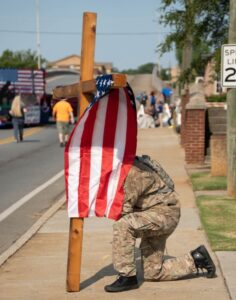
The rise in Christian Nationalism in our country is a frightening phenomenon using faith as a weapon. “Christian nationalism is an ideology that seeks to create or maintain a legal fusion of Christian religion with a nation’s character. Advocates of Christian nationalism consider their view of Christianity to be an integral part of their country’s identity and want the government to promote—or even enforce—the religion’s position within it. (Britannica.com).”
Are we, in reality, a Christian Nation? According to a Pew Research Study, the United States is a country of 342.6 million people. Of those, 62% identify as Christian, 8% other world religion, 11% atheist/agnostic and 19% no stated affiliation. When 38% of the population does not affiliate with Christianity, that is leaving 130.2 citizens unrepresented by the designation some believe should speak for all. When we consider 8% of Americans profess another world religion, that is 27.4 million people, or an amount similar to the combined populations of New York state and Massachusetts. That is a lot of people to be considered on the outside looking in.
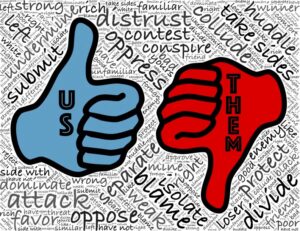
How many political ads will we see before the midterm elections? It is exhausting. The words and images are created and designed to manipulate our emotions and enrage us. It would be understandable if one wants to opt out of the entire process. We ask ourselves how to discern truth from illusion as opposing facts are presented as truth. We are inundated with biased media that is designed to sway our world view to one side or the other. Voting is a moral obligation of faithful Catholics, but how to vote requires discernment through an informed conscience. How do we strengthen and continue growing our conscience as we participate in political life?

Taking a Deeper Dive:
- Our conscience is formed through our media consumption influencing how we think and how we We want to be informed, and yet how do we keep our balance? Consider reading Consuming the News Without Letting It Consume You by Christina Littlefield from Sojourners magazine to hear specific suggestions to set media limits and keep a balanced perspective.
- Our church, through Catholic Social Teaching, teaches how to support the Common Good and the Beloved Community. Spend some time researching and in prayer as you consider candidates and issues prior to casting your
- Don’t you wish that the little angel and little devil on your shoulders were how our conscience works? Unfortunately growing and forming our conscience is a lifelong venture. Here are some suggestions to support Forming our Conscience for Civic Life.
- Get involved with the process. The League of Women Voters is a nonpartisan political organization that encourages informed and active participation in government, works to increase understanding of major public policy issues, and influences public policy through education and advocacy.
- Watch this short PBS video highlighting the historical connection between churches and voting in Milwaukee and Madison.

Moving our feet:
- Check My Vote Wisconsin to make sure you are registered and make a plan to If you need a ride to the polls or to drop off your absentee ballot, contact Souls to the Polls. Can you be a driver? Souls to the Polls is looking for volunteers to do this important work.
- Be prepared! Do your research to make sure your vote supports your Use this Checklist from Network Advocates for Catholic Social Justice using Catholic Social Teaching to evaluate candidates.
- While political ads often have opposing views, here is a Tool to find how your candidate voted on issues important to
- We are living through a period of history that can serve as an object lesson about democracy. Role model informing your conscience and casting your vote by including your children, grandchildren, or other kids in your life in the discussions and process. 11 Ways to Teach Kids about Voting and Democracy is a resource to extend that learning.
- Reach out to a person with an opposing view and start a conversation. Practice Nonviolent Communication!
- Vote early! Consider the National Early Voting Day, October 17, to participate in the election by in person early voting.